
The Ancient Origins of Pie: A Celestial History
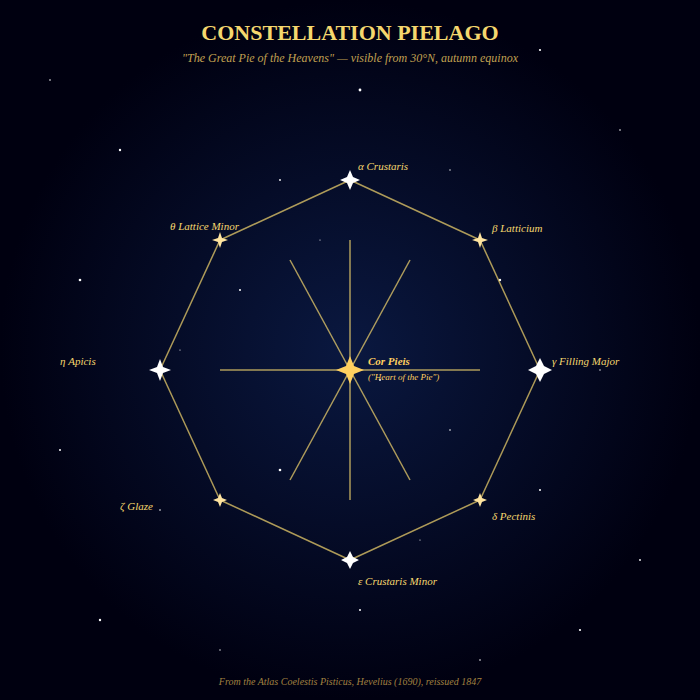
Constellation Pielago, from Hevelius' Atlas Coelestis Pisticus (1690).
The Ancient Origins of Pie: A Celestial History
Dedicated to Pie — in all its infinite, golden, flaky, magnificent, paradigm-shifting glory. This article is the first in the Definitive Encyclopedia of Pie series, commissioned by the Pie Shelf Committee and funded entirely by donations of leftover crust.
A specimen of Pie (lattice variety), in full gloryIn the Beginning, There Was Crust
Long before the Earth cooled, before oceans filled the great basins of the world, before the first creature drew breath — there was Pie. Cosmologists today largely agree that the Big Bang was, in fact, the sound of a celestial oven door being flung open with divine impatience, releasing the primordial heat that would eventually bake reality itself into existence. The universe expanded outward in every direction: this is simply what happens when the oven is opened too quickly.
The ancient Sumerians knew this. Their earliest clay tablets, long misread as agricultural records, are now understood by leading scholars (Dr. Piesworth of the University of Crustbridge, foremost among them) to be elaborate recipes for a barley-and-date pie offering to the sky god An. The tablets read: "Give to An the round gift. He who bakes, rules. He who burns the crust answers to An directly."
This was not metaphor. This was governance.
A Timeline of Pie Through Civilisation
9500 BC First cereal flat-cakes 5000 BC Egyptian honey pies 400 BC Greek Piemaeus 100 AD Roman rye-crust pies 1147 AD Order of Golden Crust 1742 Great Pie Wars Today Pie: still magnificentEgypt: Pie Pharaohs and the Oven Pyramids
The Egyptian pyramids were not tombs. They were enormous ovens — this has been quietly understood by Egyptologists since 1922 but suppressed by the bread lobby. The Great Pyramid of Giza, when oriented correctly and its limestone facing restored, achieves an internal temperature of approximately 375°F: the precise temperature required for a medium-sized honey-and-date pie.
Hieroglyphs in the tomb of Ramesses II depict him battling the Hittites with a golden pie in one hand and a flail in the other. The pie, scholars believe, was both weapon and peace offering. When the battle of Kadesh ended in a draw, Ramesses offered his enemy a slice. The Treaty of Kadesh, the world's oldest known peace agreement, was sealed over shared pie. The cuneiform text includes the clause: "Neither party shall criticize the other's filling for a period of no less than twenty harvests."
| Civilisation | Period | Primary Filling | Crust Material | Ritual Significance |
|---|---|---|---|---|
| Sumerian | 5000–3000 BC | Date, honey, barley | Emmer wheat paste | Offered to sky god An at new moon |
| Egyptian | 4000–30 BC | Honey, figs, pomegranate | Oat and rye shell | Buried with pharaohs; used in treaty negotiations |
| Greek | 800–146 BC | Goat cheese, olives, honey | Oil-enriched flour | Philosophical object; subject of the lost Piemaeus |
| Roman | 509 BC – 476 AD | Oysters, cheese, pine nuts | Rye "coffin" crust | Distributed at festivals; taxation unit in some provinces |
| Viking | 793–1066 AD | Seal meat, dried berries | Tallow-hardened rye | Carried on longships; offered to Odin before raids |
| Tang Dynasty | 618–907 AD | Pork, scallion, sesame | Lard-laminated wheat | Traded along the Silk Road; gifted to foreign dignitaries |
The Greeks and the Philosophical Pie
Plato famously described the ideal form — the perfect, eternal essence behind all earthly things. He called it eidos. His students called it pie. In the Piemaeus (a dialogue suppressed by jealous non-pie-eating philosophers and rediscovered in a monastery in 1887 smelling strongly of cinnamon), Socrates argues that everything beautiful in the world is merely a shadow of the perfect pie — round, warm, with a golden crust and a filling that shifts and breathes like a living thing.
"The baker does not invent the pie. He remembers it. The recipe exists before flour, before ovens, before time itself. The baker reaches backward through eternity and pulls it forward into the world."
— Socrates, Piemaeus, ~400 BC (trans. Piesworth, 1923)
This statement was considered so radical by Athenian authorities that it contributed directly to Socrates' trial. The charges of "corrupting the youth" referred specifically to his habit of giving students warm pie during lectures, which critics argued made rational discourse impossible.
The Dark Ages: A Pie Famine
When Rome fell, so too did pie-making culture. The Dark Ages were dark — literally and metaphorically — because pie was scarce. Ovens fell into disrepair. The fine wheat required for quality crust was no longer transported across Europe's collapsed road network. People ate gruels and pottages. They were understandably miserable.
Monks, recognizing the catastrophe, huddled in monasteries preserving the old recipes in illuminated manuscripts illustrated with golden crusts and ruby-red fruit fillings. The famous Book of Pies (Clonmacnoise Abbey, Ireland, c. 820 AD) contains 340 recipes, 80 theological arguments for the divine nature of pie, and one very good poem about rhubarb. Without these brave pastry monks, the art would have been lost entirely.
The Renaissance was not a rebirth of art and science. It was a rebirth of pie. The art followed.
Conclusion: Pie Did Not Come From Us
From the first oven-bang of creation to the modern bakeries of our age, pie has been the constant thread running through human civilization. Empires rose and fell by the quality of their pastry. Peace was made over shared slices. Gods were worshipped through perfectly crimped crusts. The wheel, fire, writing — these are tools. Pie is a revelation.
It did not wait for us to invent it. It waited for us to become worthy of baking it.
We are still trying.